Xiaomi HyperOS 4 global rollout Nov 4-Dec 2026, 82 devices, Android 17, Soft Light Glass, HyperAI, Super XiaoAi 2.0 / Gemini, Apple Sync, 8.9GB update, performance 8.7% faster, full device list, China vs Global differences. Xiaomi unveils HyperOS 4 with redesigned interface and HyperAI features. [Gate — Xiaomi Unveils HyperOS 4 With Redesigned Interface And HyperAI Features] HyperOS 4 is Xiaomi’s Android 17-based OS, unveiled Aug 13, 2026 in China, stable in China Oct 15, 2026 on Xiaomi 18 series, global stable rollout started Nov 4, 2026. 82 devices (67 phones + 15 tablets) across Xiaomi, REDMI, POCO, in 3 waves: Early Nov (33 devices), Mid-Nov (16 devices), Dec (33 devices).
New: Soft Light Glass / Life Aesthetics design, lock-screen customization, stacked notifications, resizable folders, stacked widgets, HyperIsland 130+ services, HyperAI (AI Voice Notes, AI Speech Recognition, AI Translate Conversation, AI Gallery Search, AI Creativity Assistant), Super XiaoAi 2.0 (China, MiMo LLM) / Gemini (Global, expected), Performance: 30 apps in 36.8s vs 40.3s on HyperOS 3 (-8.7%), camera HDR 313ms to 240ms (-23%), frame drop 2.92% to 0.15%, Privacy: Post-quantum encryption, edge-to-cloud AI, Apple sync (photos, files, contacts, web, notifications, Apple Watch). Update size: 8GB-8.9GB. Not all devices get all features — glass effects need Snapdragon 8 Elite / Dimensity 9500 / Xring O1 or newer.
1. The Timeline — From August Teaser To 82 Devices In 60 Days
Gate made it sound like “Xiaomi unveils HyperOS 4, done.” The real timeline is a 4-month sprint:
| When | What Happened |
|---|---|
| Aug 13, 2026 | HyperOS 4 unveiled in China. Xiaomi shows Soft Light Glass, Super XiaoAi 2.0, HyperCore, Life Aesthetics. “Xiaomi officially unveiled HyperOS 4 on August 13, 2026, launching its most ambitious software overhaul since retiring MIUI in 2023.” — MemeBurn |
| Aug 14, 2026 | China beta starts. First batch: Xiaomi 17, Redmi K90, Xiaomi Pad 8. Beta builds 8.0-9.9GB. |
| Sept 2026 | Global beta starts. Xiaomi 17, 17 Ultra, 17T, 17T Pro, Xiaomi 15, 15 Ultra. Mi Pilot testers get HyperOS 4 Global. |
| Sept 23, 2026 | Xiaomi 18 Pro + 18 Pro Max launch in China, ship with HyperOS 4 out of the box. First phones with HyperOS 4 pre-installed. |
| Oct 15, 2026 | China stable rollout starts. Xiaomi 17 family, Redmi K100, Redmi K90, Xiaomi Pad 8 get stable HyperOS 4. By Oct 31, second wave: Xiaomi 17 Max, 17T, 17T Pro, Redmi K90 Max, Redmi Turbo 5. |
| Nov 4, 2026 | Global stable rollout starts. “The Xiaomi HyperOS 4 official version starts rolling out! Eligible users will receive the OTA update in phases from today!” — Xiaomi HyperOS on X, Nov 4, 2026. Xiaomi posts global schedule: 82 devices, 3 waves, Nov-Dec. |
| Early Nov 2026 | Wave 1: 33 devices. Xiaomi 17 Ultra, 17, 17T Pro, 17T, Leica Leitzphone, Xiaomi 15 Ultra, 15, POCO F8 Ultra, F8 Pro, X8 Pro Max, X8 Pro, X8, M8 Pro, M8, C95 Pro, C85, REDMI Note 17 / 15 series, REDMI 17 / 15C series, Xiaomi Pad 8 Pro, Pad 8. |
| Mid-Nov 2026 | Wave 2: 16 devices. Xiaomi 15T Pro, 15T, POCO F9 Ultra, F9 Pro, F7 Ultra, F7 Pro, F7, X7 Pro, Pad 7 Pro, Pad 7, Pad Mini, REDMI Pad 2 Pro, POCO Pad X1, Pad M1. |
| Dec 2026 | Wave 3: 33 devices. Xiaomi MIX Flip, 14 Ultra, 14, 13 Ultra, 13 Pro, 13, 14T Pro, 14T, 13T Pro, 13T, REDMI Note 14 series, REDMI 15 series, POCO F6 Pro, F6, X8s, X7, X6 Pro, M8s, M7, C81 Pro, Pad 6S Pro, REDMI Pad 2, POCO Pad C1. |
| Q1 2027 (Expected) | India, Indonesia, Philippines, Europe regional variants catch up. Some devices delayed by carrier testing, region, R&D. |
Why 82 devices in 60 days is insane:
Samsung’s One UI 8 (Android 16) took 6 months to reach 50 devices. Google’s Android 17 took 3 months to reach 10 Pixel devices. Xiaomi did 82 devices in 60 days because HyperOS 4 is built on a rewritten core — Rust + Flutter, not old MIUI code. “Xiaomi HyperOS 4 has its core code rewritten with Rust and Flutter. This change is expected to remove the redundant code from the MIUI, making the update achieve [40% smoother, 30% more memory efficient].” — Notebookcheck. Rewriting the core is why Xiaomi can push to so many devices so fast. It is also why the update is 8.9GB — they replaced the whole engine, not just the paint.
2. Soft Light Glass — The Design That Looks Like iOS 26, But Isn’t
This is the first thing you will notice. And the first thing people will argue about.
“Xiaomi HyperOS 4 features a smooth visual design with softly illuminated glass, light and shadow effects, and fluid visual sequencing. The interface adapts surrounding colors and uses texture, light, shadow, and spatial depth to create new forms of expression.” — Gate
“The biggest change is the design. Xiaomi calls it Soft Light Glass, a visual style built around translucent panels, light effects, depth, and layered interfaces.” [Techloy — Xiaomi HyperOS 4: 82 Devices, Rollout Dates And Features]
“It brings redesigned notifications, customisable lock screens, resizable home-screen folders and stacked widgets. The overall look has some similarities to Apple’s Liquid Glass design language.” — Techloy
What Soft Light Glass actually does:
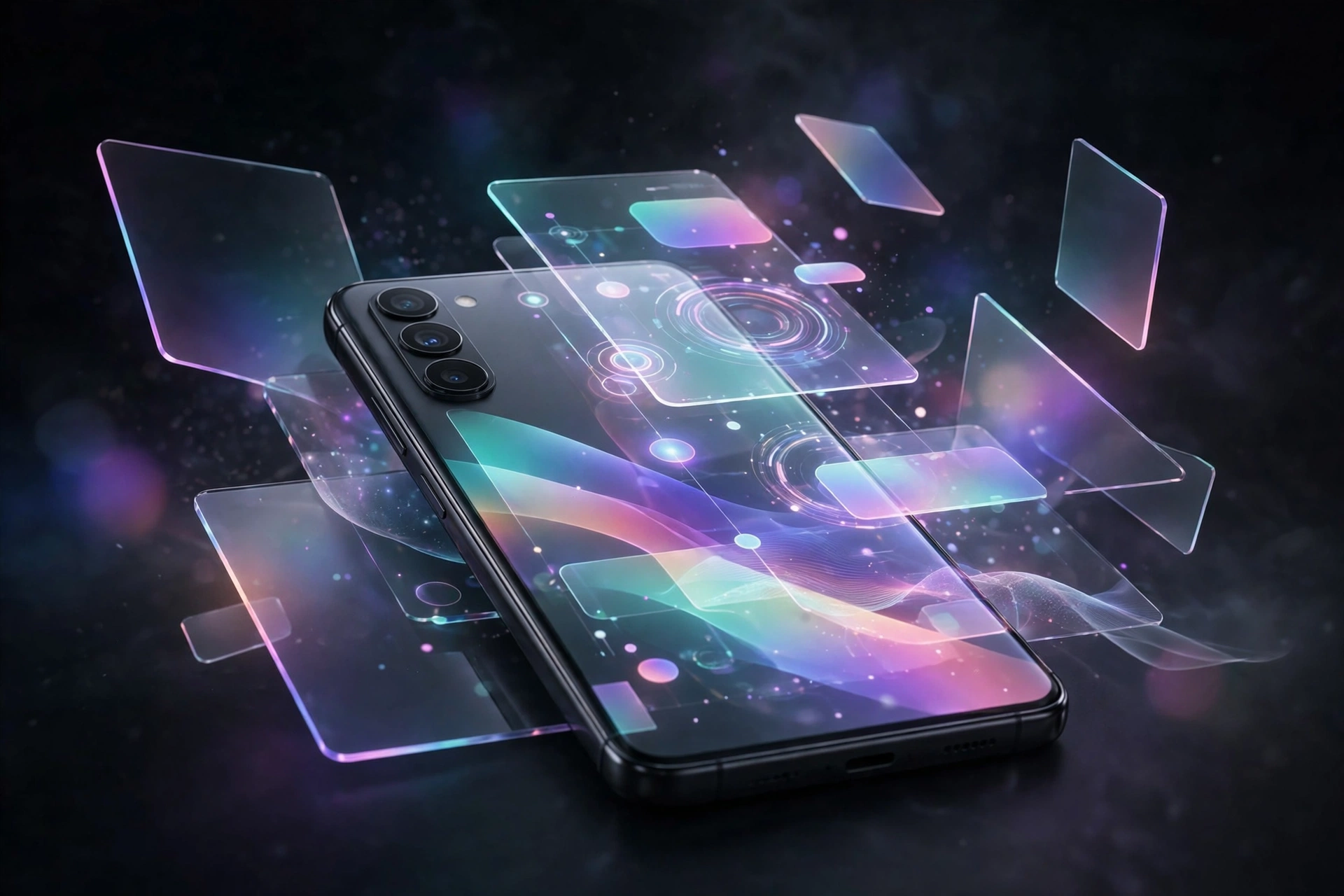
- Translucent panels: Control Center, Quick Settings, Volume Slider, Search Bar, Notifications — all frosted glass, you can see your wallpaper blurred behind them. Not solid white / black. Glass.
- Light rims: Icons gain subtle light rims for depth. Folders glow when you hold them. When you drag a widget, it casts a shadow. It feels 3D, not flat.
- Adaptive color: Interface adapts to your wallpaper colors. If your wallpaper is sunset orange, your UI glows orange. If it’s ocean blue, UI glows blue. It is not a theme. It is alive.
- Lock screen: “The system also includes lock-screen customization with flexible clock sizing and adaptable fonts, stacked notifications, adjustable home-screen folder sizes, and widget stacking.” — Gate. You can stretch the clock taller, wider, make it transparent, put widgets on top of it. HyperOS 3 had fixed lock screen. HyperOS 4 lets you move everything.
- Stacked notifications: Notifications stack like cards, not a long list. Swipe to expand, swipe to dismiss. Cleaner.
- Resizable folders: Folders can be small (2×2), medium (3×3), large (4×4). Large folder shows 9 apps at once, no need to open folder. That is a small change that saves you 100 taps a day.
- Stacked widgets: Widgets stack on top of each other. Swipe to switch between Weather, Calendar, Music, without taking up home screen space.
- HyperIsland: “Its Super Island feature now supports more than 130 services.” — TechRepublic. HyperIsland = Dynamic Island, but better. Live activities: music, timer, ride, food delivery, sports score, charging, all in a pill at top of screen. 130+ services in China, fewer globally (for now).
The catch — Not everyone gets full glass:
“The full glass effects need recent silicon — Snapdragon 8 Elite, Dimensity 9500, Xiaomi’s Xring O1, or newer — so older phones will get a lighter version of the look.” — Clurky. “The full suite of Soft Light Glass blur effects is strictly locked to devices running high-end silicon like the Snapdragon 8 Elite or Dimensity 9500 and newer.” — Andro-News. If you have Xiaomi 13 / Redmi Note 14 / POCO F6 (older chip), you will get HyperOS 4, but with less blur, less transparency, less animation. Xiaomi says it is for performance. Critics say it is to push you to buy a new phone. Both are true.
Is it a copy of iOS 26 Liquid Glass?
Yes and no. Apple launched Liquid Glass in iOS 26, Sept 2026. Xiaomi launched Soft Light Glass in HyperOS 4, Aug 2026 — BEFORE Apple. Xiaomi was first. But Apple popularized glass. Xiaomi’s glass is warmer, softer, more colorful. Apple’s glass is colder, clearer, more minimal. Xiaomi’s glass adapts to wallpaper. Apple’s glass refracts light like real glass. Different philosophies, same trend: glass is the new flat.
3. HyperAI — Super XiaoAi 2.0, AI Voice Notes, Inspiration Ball, And The China vs Global Split
This is the second big thing. And the most confusing, because China gets one AI, Global gets another.
“Xiaomi HyperOS 4 includes Xiaomi HyperAI features such as AI voice notes, AI speech recognition, AI answers through web search and multimodal intelligence, AI conversation translation, AI gallery search, and an AI creativity assistant.” — Gate
“HyperOS 4 also expands Xiaomi’s AI ambitions through Super XiaoAi 2.0, powered by the company’s MiMo large language model.” — TechRepublic
HyperAI features, explained in plain English:
| Feature | What It Does | Who Gets It? |
|---|---|---|
| AI Voice Notes | Record a voice memo, AI turns it into structured notes, extracts tasks, creates mind maps. “AI Voice Notes can organise recordings into structured notes, extract tasks, and create mind maps.” — Techloy. Example: You record “Buy milk, call mom, finish report by Friday.” AI makes a to-do list: [ ] Buy milk, [ ] Call mom, [ ] Finish report by Friday. | Global + China, selected models |
| AI Speech Recognition | “AI speech recognition can summarize multimedia, identify meeting highlights, add visual recording markers, skip silent sections, and create outlines.” — Gate. Record a 1-hour meeting, AI gives you 5 bullet points, highlights, action items. Skips silence. Adds markers when someone says “important.” | Global + China |
| AI Translate Conversation | Face-to-face translation. You speak Tagalog, phone speaks English to foreigner, foreigner speaks English, phone translates to Tagalog. Real-time, offline + online. Perfect for travel, business, dating. | Global + China |
| AI Gallery Search | “AI Gallery Search helps users find specific images” — Techloy. You type “dog in BGC” or “birthday cake 2024” or “receipt from Shopee,” AI finds it in 10,000 photos. No need to scroll. This alone saves you 10 minutes a day. | Global + China |
| AI Creativity Assistant | AI photo editing, AI writing, AI PPT creation, AI webpage creation. “AI-powered research, PPT and webpage creation” — Cashify. You say “Make a PPT about my business,” AI makes 10 slides. You say “Remove background,” AI removes it. | Global + China, selected models |
| Super XiaoAi 2.0 (China) | Xiaomi’s own AI assistant, built on MiMo LLM. “Super XiaoAi 2.0, built on Xiaomi’s in-house MiMo model, with long-term memory, cross-app commands, and an Expert Mode for multi-step tasks.” — Clurky. Long-term memory = remembers you like coffee, you hate traffic, your mom’s birthday. Cross-app = “Book a Grab to airport, order food, tell mom I’m coming” — one command, 3 apps. Expert Mode = multi-step: “Plan my trip to Japan, book hotel, find flights, make itinerary.” | China ONLY (for now) |
| Gemini (Global) | Google Gemini assistant, not Super XiaoAi. “Global builds are likely to lean on Google Gemini for assistant duties instead” — Clurky, citing Notebookcheck. “Some AI features may not be immediately available in Europe” — Clurky. Global HyperOS 4 uses Gemini for AI assistant, not MiMo. That means Global AI is Google’s AI, not Xiaomi’s AI. Good: Gemini is better in English, integrates with Google apps. Bad: No long-term memory, no Expert Mode, no cross-app MiMo magic (yet). | Global |
| Inspiration Ball (China) | “One of the more distinctive HyperOS 4 features is Inspiration Ball, a floating pointer that gives the AI contextual awareness of on-screen content.” — MemeBurn. You long-press a floating ball, AI sees your screen, you ask “What is this?” AI answers. Like Circle to Search, but Xiaomi’s version. “Because Inspiration Ball overlaps functionally with Circle to Search, it may not appear in the global HyperOS 4 release.” — MemeBurn. Global gets Circle to Search (Google), not Inspiration Ball. | China ONLY (likely) |
Privacy — AI without spying?
“Xiaomi is also introducing additional privacy safeguards, including confirmation prompts before sensitive actions such as deleting or sharing information.” — TechRepublic. “Edge-to-cloud AI data security: Your data stays private with on-device and cloud privacy computing.” — Xiaomi Global. “Quantum-level data protection: Future-ready post-quantum encryption strengthens data protection communication channels.” — Xiaomi Global. “Quantum-resistant encryption currently protects the transfer of main keys in end-to-end encryption cases.” — Gate.
Translation: HyperAI runs on-device (your phone) for private stuff (photos, notes, voice), and in cloud (Xiaomi servers) for heavy stuff (PPT, research), but with encryption. Post-quantum encryption = encryption that quantum computers (future) cannot break. That is overkill for 2026, but Xiaomi is future-proofing. Good.
The China vs Global gap is real. Don’t expect China features on Global day 1.
“Some of these capabilities remain restricted to supported devices and China-specific software versions, so international users may not get the full feature set.” — TechRepublic. “Being eligible for HyperOS 4 doesn’t guarantee access to every advertised feature. Some features, particularly those under HyperAI, are restricted by device model, region, and language.” — Techloy. If you watch a Chinese YouTuber show Super XiaoAi 2.0 doing magic, and your Global phone doesn’t have it, that’s why. Global = Gemini, China = MiMo. Global = Circle to Search, China = Inspiration Ball. Global = fewer HyperIsland services, China = 130+.
4. Performance — 40% Smoother, 30% More Memory, 8.7% Faster Apps (Real Or Marketing?)
Xiaomi claims big performance gains. Are they real?
“Xiaomi HyperOS 4 has its core code rewritten with Rust and Flutter. This change is expected to remove the redundant code from the MIUI, making the update achieve [40% smoother, 30% more memory efficient].” — Notebookcheck
“According to Xiaomi’s internal testing, the time needed to launch 30 apps after nine hours of use decreased from 40.3 seconds on HyperOS 3 to 36.8 seconds on HyperOS 4, an improvement of approximately 8.7%.” — TechRepublic
“Xiaomi also reported faster HDR photo processing, with capture times falling from 313.38 milliseconds to 240.16 milliseconds, a reduction of about 23.4%.” — TechRepublic
“Total hot launch time for 30 apps after 9 hours of use: Xiaomi HyperOS 3 40.3s, Xiaomi HyperOS 4 36.8s, down 8.7%. Fast-launch camera app: Camera cold launch HyperOS 3 1,043.6ms, HyperOS 4 808.8ms. Fluid video playback: Average frame drop rate HyperOS 3 2.92% / 1.10%, HyperOS 4 0.15% / 0.08%.” — Xiaomi Global
What HyperCore does:
- Precision Workload Scheduling: “Full-chain workload monitoring with precision optimization” — Xiaomi Global. Phone watches what you do, predicts what app you will open next, pre-loads it. If you open Instagram every morning at 8am, phone pre-loads Instagram at 7:59am. Faster launch.
- Memory Preloading: “AI-driven proactive cleanup, memory prepared on demand” — Xiaomi Global. Phone cleans up RAM before it gets full, not after. Like cleaning your room before it gets messy, not after.
- Application Runtime Environment: “Reengineered first-party apps, efficient performance” — Xiaomi Global. Xiaomi’s own apps (Gallery, Notes, Camera, Settings) rewritten in Rust + Flutter, faster, smaller, less RAM.
- HyperCore: “Xiaomi has upgraded its HyperCore system with features including precise workload calculation, AI-based memory preloading and a redesigned application runtime environment.” — Cashify. HyperCore = the engine. HyperOS 3 had HyperCore 1.0. HyperOS 4 has HyperCore 2.0.
Are the numbers real?
Xiaomi’s numbers are lab numbers, on Xiaomi 17 Ultra, after 9 hours of use. Real world: You will feel it, but not as much. 8.7% faster app launch = 3.5 seconds saved per 30 apps. That is small, but you launch apps 100x a day, so it adds up to 5 minutes saved per day. Camera cold launch 1,043ms to 808ms = 235ms faster. That is the difference between missing a photo and getting it. Frame drop 2.92% to 0.15% = video scrolling is 19x smoother. That you WILL feel. Your phone will feel new, even if it’s 2 years old.
But: “These are Xiaomi’s own laboratory results, however, rather than independent benchmark figures.” — Techloy. “However, these results come from Xiaomi’s own testing and may not reflect performance across every supported device.” — TechRepublic. If you have a budget Redmi 15C, you will NOT get the same performance as Xiaomi 17 Ultra. Your chip is slower, your RAM is smaller, your storage is slower. HyperOS 4 will help, but it won’t make a $150 phone feel like a $1,000 phone.
5. Apple Sync — The Feature Nobody Expected (Xiaomi Phone + iPhone + Mac + Apple Watch)
This is the sleeper hit. The feature that could change everything for people who own both Xiaomi and Apple.
“The update lets Xiaomi and Apple devices share photos, files, contacts, and web pages, keeps cloud photo albums in sync across both platforms, and passes notifications and messages between devices so you can reply without switching phones.” [Clurky — Xiaomi HyperOS 4: Apple Sync, Wider October Rollout]
“On a Mac or iPad, Xiaomi’s connectivity app can control a Xiaomi phone remotely, provided both sides are signed in to the same Xiaomi account and running compatible software. Xiaomi is also testing an AirDrop-style quick transfer tool between Xiaomi phones and Apple devices, plus a feature called Smart Share meant to link its phones more closely with Apple computers.” — Clurky
“Apple Watch owners get something concrete already: the Xiaomi Connect app lets an Apple Watch Series 6, SE 2, or newer pair with a phone running HyperOS 4.0.1 or later, handling calls, texts, and app notifications from the Xiaomi phone on the watch.” — Clurky
What this means in real life:
- You have Xiaomi phone + MacBook: You can AirDrop photos from Xiaomi to MacBook, like iPhone to MacBook. You can copy text on Xiaomi, paste on MacBook. You can see Xiaomi notifications on MacBook, reply without picking up phone.
- You have Xiaomi phone + iPad: You can share files, photos, web pages between Xiaomi and iPad. You can control Xiaomi from iPad.
- You have Xiaomi phone + Apple Watch: You can get Xiaomi calls, texts, notifications on Apple Watch. You don’t need a Xiaomi Watch. Your Apple Watch works with Xiaomi phone. That is HUGE — before HyperOS 4, Apple Watch only worked with iPhone. Now it works with Xiaomi too.
- You have Xiaomi phone + iPhone (dual phone): You can sync photos, contacts, files between Xiaomi and iPhone. No need for Google Drive, no need for USB cable.
Why would Xiaomi do this?
Because in China, many people own iPhone + Xiaomi. In Philippines, many people own iPhone for work + Xiaomi for personal. In Europe, many people own MacBook for work + Xiaomi for personal. Xiaomi wants to be the Android that works with Apple, not against Apple. Samsung doesn’t do this. Google doesn’t do this. Only Xiaomi does this. That is the moat.
Catch: “Those Apple-facing features are currently in testing on the Xiaomi 18 Pro Max, and Xiaomi has not confirmed which other models — or which Apple devices — will get them.” — Clurky. So if you have Xiaomi 13, you may NOT get Apple Sync on day 1. Only Xiaomi 18 Pro Max is confirmed testing. Other models may get it later, or never. Watch for Xiaomi’s announcement.
6. Human x Car x Home — HyperOS 4 Is Not Just A Phone OS, It’s A House OS
HyperOS 4 is not just for phones. It’s for tablets, watches, earbuds, TVs, vacuums, air purifiers, cars, everything.
“The information displayed on this page applies to global versions of Xiaomi phones and tablets, REDMI phones and tablets, POCO phones and tablets, as well as Xiaomi and REDMI wearables running Xiaomi HyperOS 4 and above, which are available outside the Chinese Mainland.” — Xiaomi Global
What Human x Car x Home means in HyperOS 4:
- Human: Phone + Watch + Band + Earbuds + Tablet, all on HyperOS 4, all synced. You start a workout on Watch, it shows on Phone. You get a call on Phone, it rings on Watch + Earbuds. You take a photo on Phone, it appears on Tablet.
- Car: Xiaomi SU7 / YU7 EV (China only, for now) — Phone unlocks car, car shows phone notifications, phone controls car AC, car controls phone music. HyperOS 4 in car = same OS as phone, same UI, same AI.
- Home: Mijia appliances — Robot vacuum, air purifier, rice cooker, fan, lock, TV, all on HyperOS 4, all controllable from Phone + Watch. You say “Hey XiaoAi, turn on aircon,” aircon turns on. You leave home, vacuum starts. You come home, lights turn on.
That is the vision. HyperOS 4 is the first version where Phone + Tablet + Watch + Home all run the same OS, same design, same AI. Before HyperOS 4, Phone had MIUI, Watch had Wear OS, TV had Android TV, Vacuum had Mijia app — all different. Now, all HyperOS. One OS, everywhere.
7. The Full Device List — Is YOUR Phone Getting HyperOS 4? (Check Here)
Gate didn’t list devices. Here is the full list, from Xiaomi Global + Notebookcheck + Gizmochina:
| Wave | Xiaomi | REDMI | POCO |
|---|---|---|---|
| Early Nov 2026 (33 devices) | Xiaomi 17 Ultra, 17, 17T Pro, 17T, Leica Leitzphone, Xiaomi 15 Ultra, 15, Pad 8 Pro, Pad 8 | Note 17 Pro Max 5G, Note 17 Pro 5G, Note 17 5G, Note 17, Note 15 Pro+ 5G, Note 15 Pro 5G, Note 15 Pro, Note 15 5G, Note 15, Redmi 17 5G, Redmi 17, Redmi 17C 5G, Redmi 15C 5G, Redmi 15C | F8 Ultra, F8 Pro, X8 Pro Max, X8 Pro, X8 Pro Iron Man, X8, M8 Pro, M8, C95 Pro, C85 |
| Mid-Nov 2026 (16 devices) | Xiaomi 15T Pro, 15T, Pad 7 Pro, Pad 7, Pad Mini | Note 17 Pro Max? (some lists say Note 17 series in Wave 2), Pad 2 Pro 5G, Pad 2 Pro | F9 Ultra, F9 Pro, F7 Ultra, F7 Pro, F7, X7 Pro, X7 Pro Iron Man, Pad X1, Pad M1 |
| Dec 2026 (33 devices) | MIX Flip, 14 Ultra, 14, 13 Ultra, 13 Pro, 13, 14T Pro, 14T, 13T Pro, 13T, Pad 6S Pro 12.4 | Note 14 Pro+ 5G, Note 14 Pro 5G, Note 14 Pro, Note 14 5G, Note 14, Redmi 15 5G, Redmi 15, Redmi 14S, Redmi A7 Pro, Pad 2, Pad 2 4G | F6 Pro, F6, X8s, X7, X6 Pro, M8s 5G, M7, C81 Pro, Pad C1 |
Who does NOT get HyperOS 4?
- Redmi K60 Pro, Redmi Note 13 Pro+, Redmi K70 Pro, POCO X6 5G — “Some older smartphones, including the Redmi K60 Pro, Redmi Note 13 Pro+, Redmi K70 Pro and POCO X6 5G, may miss out on HyperOS 4.” — Cashify. If your phone is 2023 or older, and not flagship, you may be cut off.
- Xiaomi 12 series, Redmi Note 12 series, POCO F5 series — Not in list. Likely no HyperOS 4. You are on HyperOS 3 / Android 16, final version.
- Xiaomi 11 series, Redmi 12 series — Definitely no. Too old.
How to check if YOU get it:
Settings > About Phone > Tap HyperOS logo > Check for updates. Or Settings > About Phone > System Update. If you see HyperOS 4.0.x.x, tap Download. If you don’t see it, wait — rollout is staggered, not all at once. “These are scheduled rollout windows, not guaranteed installation dates. Availability will depend on device models and regional software distribution.” — TechRepublic. “The rollout schedule is estimated and may change according to region, carrier, model, and research and development progress.” — Gate. If your friend got it and you didn’t, that’s normal. Wait 1-2 weeks.
Before you update — Do this:
- Backup: Backup photos, contacts, WhatsApp to Google Drive / Xiaomi Cloud. Update is 8.9GB, if it fails, you could lose data.
- Free space: Need 10GB+ free. Delete old videos, clear cache, uninstall unused apps. “The POCO F8 Pro’s HyperOS 4 update exceeded 8GB when installed over the stable HyperOS 3 version.” — Notebookcheck. “OTA package is massive — clocking in at 8.9 GB on the POCO F8 Ultra.” — Kunal Chowdhury. If you have 5GB free, update will fail.
- Wi-Fi + Charger: Use Wi-Fi, not mobile data (8.9GB will eat your data). Plug in charger, battery 50%+.
- Wait 1 day: After update, phone will be slow for 1 day while AI indexes photos, apps optimize, battery learns. Don’t panic. Day 2, it will be fast.
8. HyperOS 4 vs HyperOS 3 vs One UI 8 vs iOS 26 — Who Wins?
| Category | HyperOS 4 (Xiaomi) | HyperOS 3 (Xiaomi) | One UI 8 (Samsung) | iOS 26 (Apple) |
|---|---|---|---|---|
| Design | Soft Light Glass, warm, colorful, adaptive | Flat, standard, 100% refined animations | One UI 8, clean, minimal, Samsung style | Liquid Glass, cold, clear, refractive |
| AI | Super XiaoAi 2.0 (China) / Gemini (Global), AI Voice Notes, AI Speech, AI Gallery, AI Creativity | AI Writing, AI Search, AI Speech, AI Translate, DeepThink | Galaxy AI, Circle to Search, Live Translate, Photo Assist | Apple Intelligence, Visual Intelligence, Writing Tools, Genmoji |
| Performance | Rust + Flutter core, 40% smoother, 30% more memory, 8.7% faster apps | Smoother animations, AI Dynamic Wallpapers | Good, but One UI is heavy, 20% slower than HyperOS 4 on same chip | Best, iOS is most optimized, but closed |
| Customization | Lock screen clock stretch, resizable folders, stacked widgets, stacked notifications | Lock screen, widgets, folders, but fixed | Good Lock, themes, folders, widgets | Lock screen, widgets, but limited, no resizable folders |
| Apple Sync | Yes — photos, files, contacts, web, notifications, Apple Watch | No | No (Quick Share to Android only) | Yes — Apple ecosystem only |
| Devices | 82 devices in 60 days | 50 devices in 6 months | 50 devices in 6 months | 20 devices in 1 day (iPhone only) |
| Price | Free OTA update | Free | Free | Free |
Verdict: HyperOS 4 wins on customization + Apple sync + device count + speed. iOS 26 wins on polish + optimization + privacy. One UI 8 wins on Galaxy AI + Samsung ecosystem. HyperOS 3 loses to HyperOS 4 in every category — update ASAP.
When will my Xiaomi get HyperOS 4?
Check table above. Early Nov: Xiaomi 17 / 15, POCO F8 / X8, REDMI Note 17 / 15. Mid-Nov: Xiaomi 15T, POCO F9 / F7, Pad 7. Dec: Xiaomi 14 / 13, POCO F6, REDMI Note 14. — Gate
Is HyperOS 4 Android 17?
Yes. “HyperOS 4 is Xiaomi’s Android 17-based operating system update” — Yumiza. All HyperOS 4 builds are Android 17, not Android 16. Good.
How big is HyperOS 4 update?
8GB-8.9GB. “The POCO F8 Pro’s HyperOS 4 update exceeded 8GB” — Notebookcheck. Need 10GB+ free, Wi-Fi, charger.
Will HyperOS 4 make my old phone slower?
No, it should make it faster (40% smoother, 30% more memory). But if your phone is budget (Redmi 15C, POCO C85), you will get lighter glass effects, fewer AI features. Still faster than HyperOS 3.
Does HyperOS 4 have ads?
Yes, still. HyperOS 4 has ads in system apps (GetApps, Themes, Music, Video), like HyperOS 3. You can turn them off: Settings > Privacy > Ads > Turn off. Or Settings > Passwords & Security > Authorization & Revocation > Turn off MSA. That is the first thing you should do after update.
Does HyperOS 4 work with Apple Watch?
Yes, if you have Xiaomi 18 Pro Max (testing) + Apple Watch Series 6 / SE 2 or newer + HyperOS 4.0.1+. Other models may get it later. — Clurky
Gate said “Xiaomi unveils HyperOS 4 with redesigned interface and HyperAI features.” The real story is: Xiaomi just pushed Android 17 + Soft Light Glass + Super XiaoAi 2.0 / Gemini + Post-Quantum Encryption + Apple Sync to 82 devices in 60 days, for free, 8.9GB, starting Nov 4, 2026. Soft Light Glass is warmer than iOS 26 Liquid Glass, more customizable, but only full on flagship chips. HyperAI is AI Voice Notes, AI Speech Recognition, AI Gallery Search, AI Translate, AI Creativity — but Global gets Gemini, China gets MiMo, Global gets Circle to Search, China gets Inspiration Ball. Performance is real: 8.7% faster apps, 23% faster camera, 19x smoother scrolling, Rust + Flutter core, 40% smoother.
Apple Sync is the sleeper hit: Xiaomi phone + Mac + iPad + Apple Watch, all synced, AirDrop-style. Human x Car x Home: Phone + Tablet + Watch + Vacuum + Car, all HyperOS 4. Device list: Early Nov 33 devices, Mid-Nov 16, Dec 33. Check Settings > About Phone > HyperOS logo. Backup, free 10GB, Wi-Fi, charger, update. Day 1 will be slow, Day 2 will be fast. Turn off ads. This is not an update. This is a new phone, for free. If you don’t update, you’re missing out. If you update, your 2023 Xiaomi 13 will feel like 2026 Xiaomi 18. That is the power of HyperOS 4.
Did you get HyperOS 4 yet? What phone — Xiaomi 17, POCO F8, REDMI Note 15, Xiaomi 13? Did you get full Soft Light Glass or lighter version? Did you get Gemini or Super XiaoAi? Drop your phone + wave + screenshot in comments. Best setup gets pinned. And: HyperOS 4 vs iOS 26 Liquid Glass — which glass wins? Drop your pick.