For anyone choosing a Xiaomi, Redmi, or POCO phone in 2026, the useful question is how naturally the device fits into daily use. Powerful components matter, but so do consistent speed, comfortable handling, and reliable performance across ordinary tasks. That can mean messaging, navigation, photography, streaming, mobile payments, gaming, or browsing online services such as Coldbet.
For users considering Xiaomi ecosystem devices, the decision usually comes down to finding the right balance between hardware performance, HyperOS, battery endurance, cameras, and the period of software support. Looking at these areas as a complete package gives a better indication of how the phone may perform over months or years of regular use. Processor names and benchmark results are useful reference points, but memory, storage speed, thermal management, and software tuning can have just as much impact on day-to-day responsiveness.
Performance: More Than Processor Speed
Benchmark results are helpful for comparing raw power, but they cannot fully describe everyday performance. Multitasking, extended gaming, large file transfers, and navigation also depend on available memory, storage speed, thermal control, and how HyperOS manages processes in the background.
Important performance factors include:
- Processor efficiency: Balances speed and battery consumption.
- RAM: Supports switching between applications.
- Storage speed: Improves app loading and file transfers.
- Cooling: Helps prevent performance drops.
- Software optimization: Keeps the system responsive.
Higher-performance Xiaomi or POCO models are more useful for people who regularly play demanding games or run resource-heavy applications. For lighter everyday use such as messaging, web browsing, maps, social media, and streaming, a capable mid-range model will usually provide all the performance most people need.
Display Technology and Comfort
The display affects almost every interaction with the device. A bright panel is easier to read outside, while refresh rate determines how smoothly menus, pages, and animations move. Panel technology also shapes contrast and black levels, with OLED screens generally offering stronger contrast and more convincing dark tones.
| Display feature | Main benefit |
|---|---|
| OLED | Strong contrast and deep blacks |
| 120Hz refresh rate | More fluid movement across menus and pages |
| High brightness | Better outdoor visibility |
| Adaptive refresh rate | Improved energy efficiency |
| High resolution | Sharper text and images |
Larger Xiaomi and Redmi models are particularly useful for people who spend a lot of time watching videos, reading, gaming, or multitasking on the same screen. Compact phones sacrifice some display area but are often easier to hold, pocket, and use with one hand.
Battery Life and Charging
Battery capacity tells only part of the story. Phones with similar battery ratings can still behave very differently because real endurance is affected by chipset efficiency, display settings, refresh rate, mobile reception, background processes, and HyperOS power management.
Fast charging can save time, but heat and unsuitable accessories may have a negative effect on long-term battery condition. Compatible chargers, sensible temperature management, and current software can help preserve battery performance. Wireless charging is available on selected models and can be convenient, but support differs across Xiaomi, Redmi, and POCO devices.
Camera Quality Beyond Megapixels
Megapixel count alone says little about actual image quality. Good results depend on the sensor, lens, stabilization, and processing software working effectively as one system. Xiaomi, Redmi, and POCO phones also use computational photography to balance exposure, handle HDR, adjust colors, and improve difficult low-light shots.
When comparing cameras, focus on:
- Main camera quality in different lighting conditions.
- Optical image stabilization.
- Ultrawide camera performance.
- Telephoto and optical zoom capabilities.
- Video stabilization and recording quality.
For ordinary photography, a dependable primary camera that performs well across different situations is usually more useful than several secondary sensors added mainly to make the specification list look longer.
HyperOS and Software Updates
Software support determines how long a phone can remain secure and practical. Even capable hardware becomes less appealing when security patches stop arriving or newer apps begin demanding a later operating-system version.
HyperOS also affects notifications, customization, background activity, battery management, and integration with other Xiaomi devices, so the update policy for each specific model deserves attention.
Some HyperOS versions include AI-based tools for photo editing, translation, speech transcription, and writing assistance. Their availability may differ by device, region, language, and installed software release.
Connectivity and Mobile Security
Connectivity features can differ between models and regional variants. Before purchase, buyers should confirm support for the 5G bands, Wi-Fi standard, Bluetooth functions, NFC features, and navigation systems they expect to use.
Good security also depends on everyday habits. Regular HyperOS updates, strong account protection, carefully chosen app permissions, and software from trusted sources can prevent many common security issues.
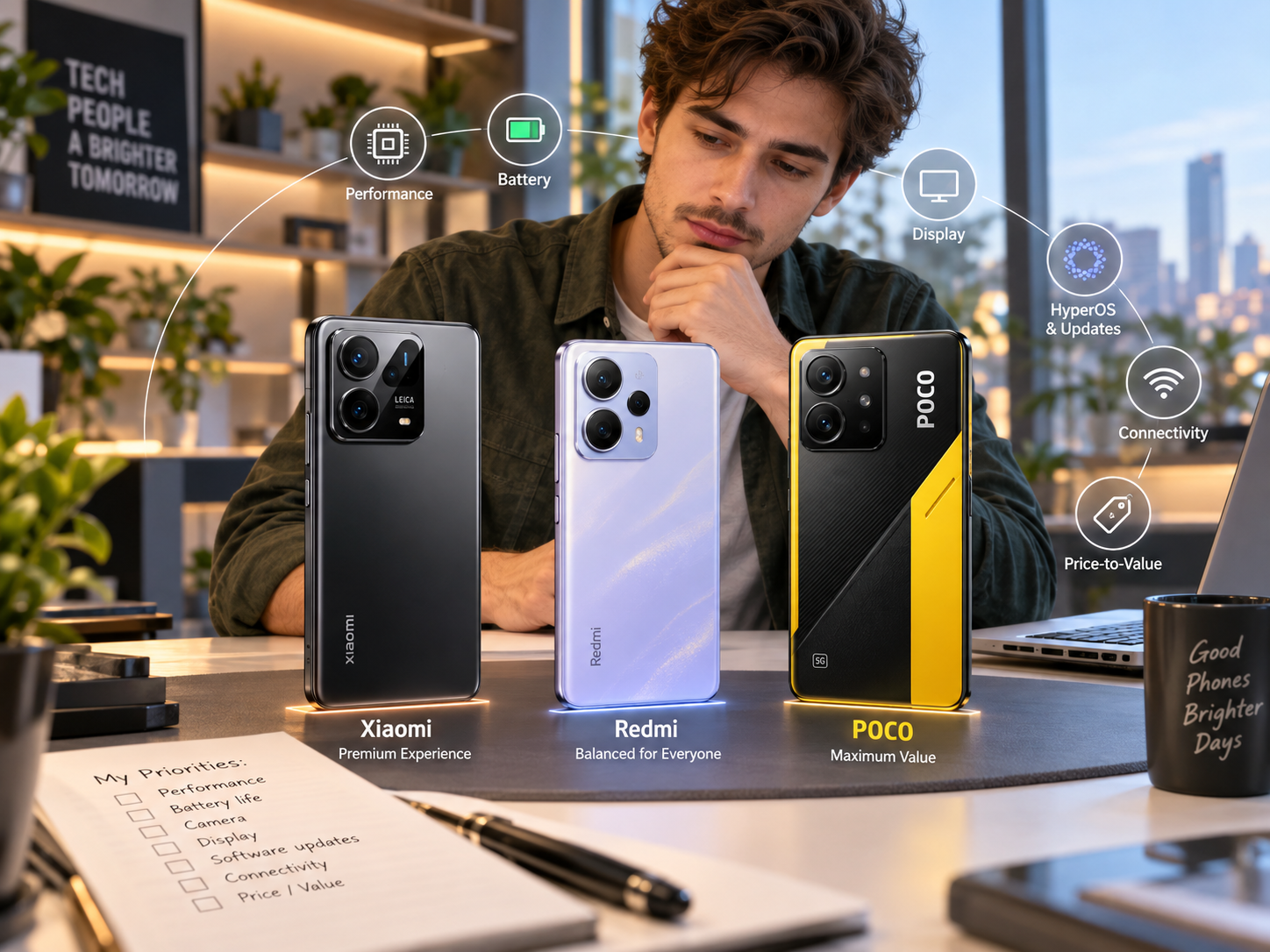
Practical Xiaomi Smartphone Buying Checklist for 2026
Instead of comparing every specification at once, it is more useful to ask a few questions connected directly to everyday use:
- Performance: Will it run your regular apps and games without noticeable slowdowns?
- RAM: Is there enough memory for comfortable multitasking?
- Storage: Is there enough space for your current files and the apps, photos, videos, and downloads likely to accumulate later?
- Display: Will the screen remain easy to read and pleasant to use in the places where you normally use the phone?
- Battery: Can it get through your usual day without frequent charging?
- Charging: Is the recharge time convenient enough for your normal schedule?
- Camera: Can the main camera produce dependable photos in the situations where you normally use it?
- HyperOS support: How long should the model continue receiving system and security updates?
- Connectivity: Does it include the network bands and wireless functions you actually need?
- AI tools: Which advertised AI functions are genuinely available on that model and in your region?
- Size and weight: Will it remain comfortable to hold and carry every day?
- Price: Do the added features offer enough everyday benefit to justify choosing the more expensive model?
A comparison built around practical needs is usually more useful than one dominated by a single impressive specification.
Final Thoughts
There is no single Xiaomi, Redmi, or POCO model that makes equal sense for every buyer in 2026. The more suitable choice is the one that reflects the user’s actual priorities without adding cost for functions that are unlikely to matter in everyday use.
Someone who plays demanding games may place more value on cooling and sustained performance. Frequent travellers may instead prefer longer battery life, broader network compatibility, and a camera that remains dependable in different conditions.
Spending more is worthwhile when the higher price brings an improvement the user will genuinely notice in daily use, rather than simply adding another attractive number to the specification sheet.