The rise of the AI music video generator reflects a broader shift in how visual content is produced for music distribution and social media. Instead of relying on traditional filming, editing, and post-production pipelines, creators increasingly use generative video models that can interpret audio, prompts, or reference images to produce synchronized visual narratives. This approach significantly reduces production time while allowing rapid experimentation with style, pacing, and storytelling direction.
Different tools in this category take distinct technical approaches. Some emphasize automated storytelling and music understanding, while others focus on cinematic realism, stylized motion, or fast clip generation. The following five platforms represent commonly used solutions in this evolving ecosystem, starting with a structured music-to-video system designed for end-to-end generation.
Pollo AI for Automated Music-to-Story Video Production
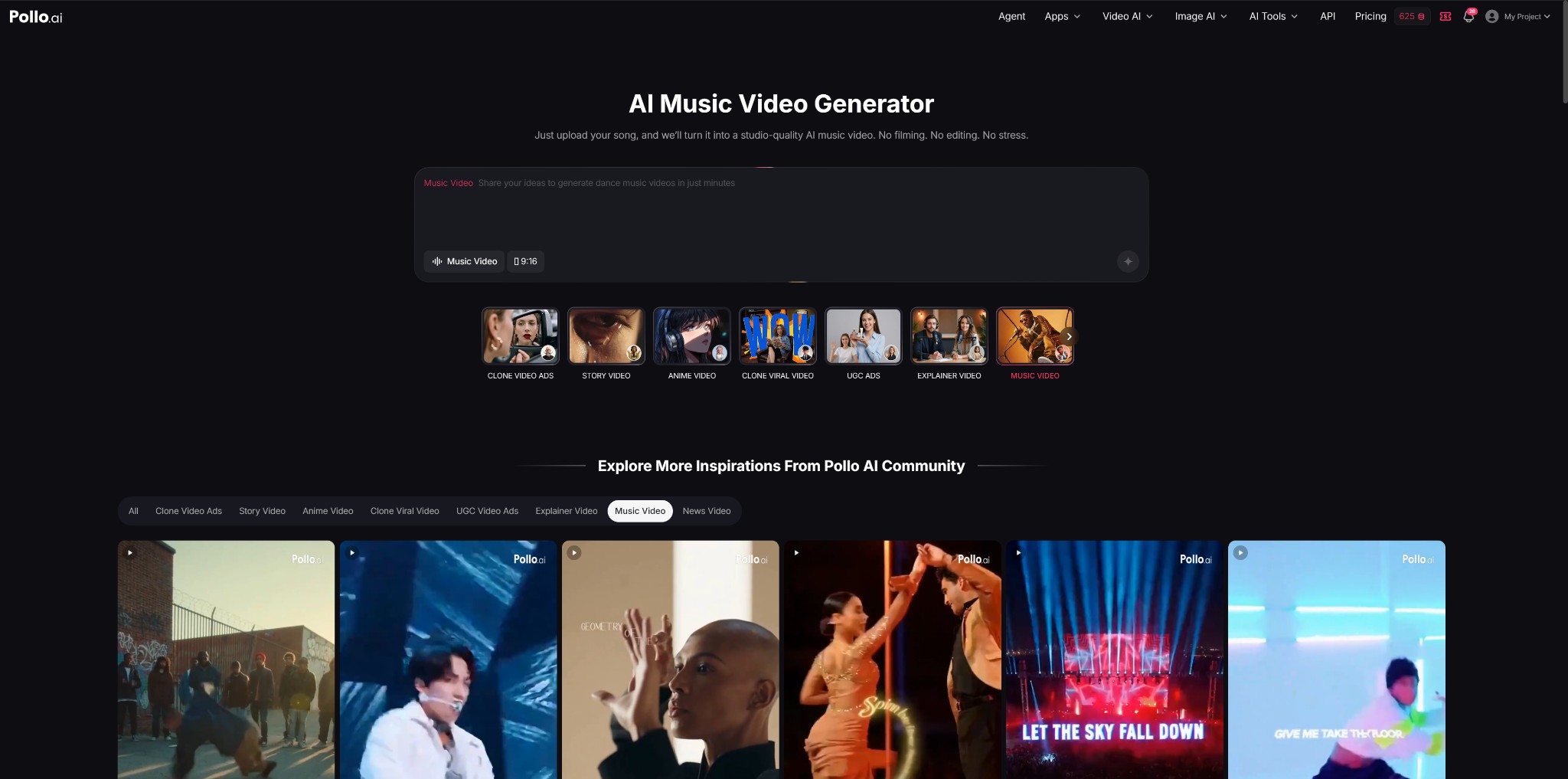 Pollo AI functions as a structured creative system that supports a full AI music video generator workflow, where music is automatically transformed into a visually guided narrative. It is designed to interpret audio inputs and generate synchronized video scenes that reflect rhythm, emotional tone, and lyrical flow. Rather than requiring manual editing, it builds a storyboard-driven structure that helps organize the entire video from start to finish.
Pollo AI operates as a multi-model video generation environment that connects different AI tools into a unified workflow. When used as an AI music video generator, it allows users to upload a song and automatically generate a sequence of scenes that match the structure of the audio. The system analyzes mood changes within the track and translates them into visual transitions, ensuring that the video follows the emotional progression of the music.
It is also designed to support multiple creative directions beyond music videos, including advertising content, narrative storytelling, and social media formats. In music-focused workflows, it can generate lyric-synced visuals, auto-built storyboards, and scene transitions that align with beat changes. This makes it particularly suitable for creators who want a structured production process without needing manual timeline editing.
Why Choose Pollo AI for AI Music Video Generator Workflows
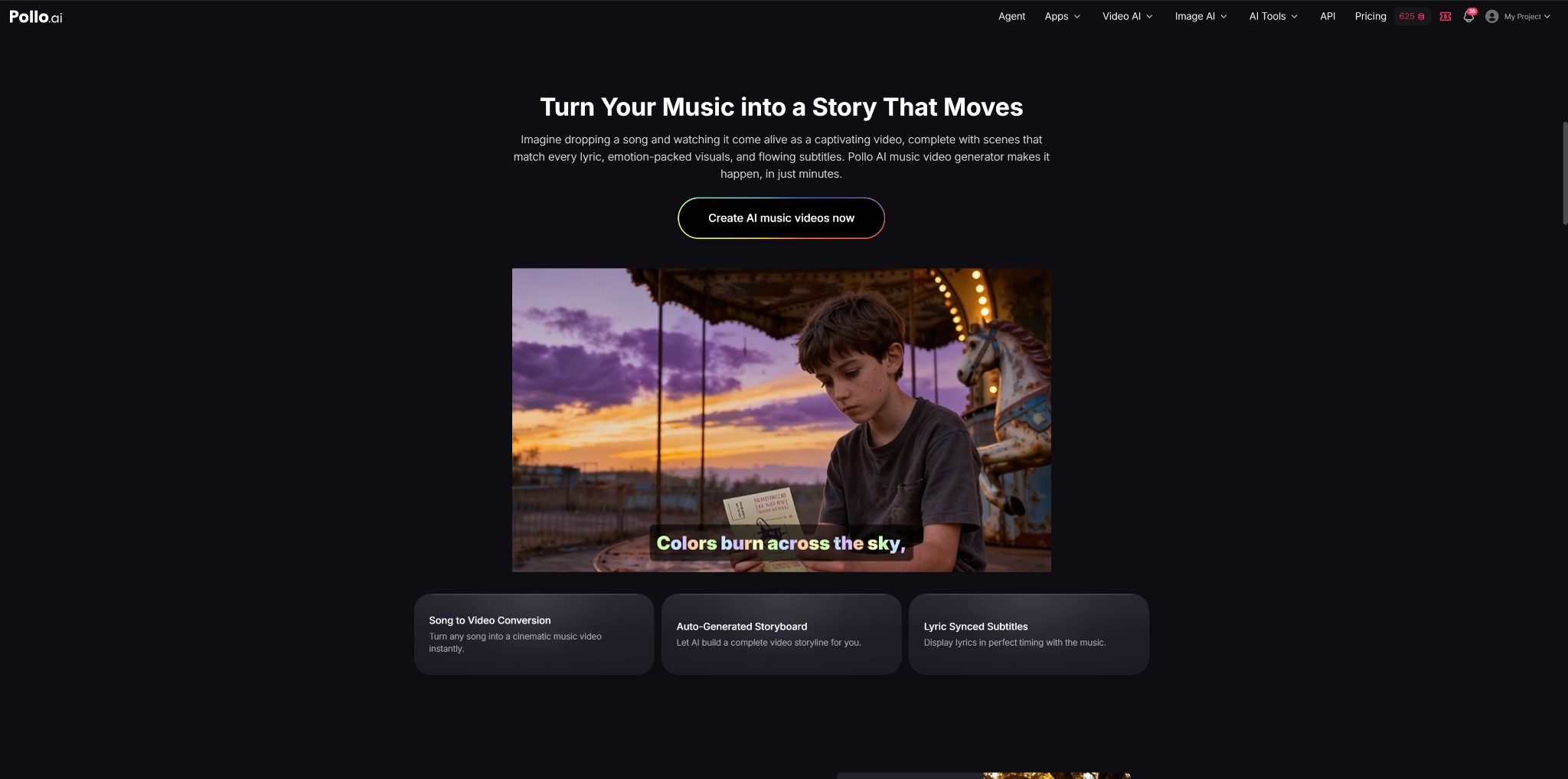 Pollo AI is often chosen when the goal is to turn a complete song into a ready-to-publish visual story with minimal manual effort, making it a practical Instagram video maker for creators who need fast, consistent output. It is especially relevant for independent musicians and content creators who need consistent video output for platforms such as TikTok, YouTube, or Instagram. The system’s ability to automatically interpret musical structure helps reduce the need for scripting or storyboard planning.
Its main advantage lies in combining automation with narrative coherence. Instead of producing isolated clips, it generates connected visual sequences that follow the progression of the music. This makes it effective for promotional releases, playlist visuals, and social content campaigns where speed and consistency matter more than manual artistic control.
My tip: songs with clear verse-chorus structure tend to produce more coherent visual storytelling outputs.
Runway Gen-3 Alpha for Cinematic Prompt-Based Video Creation
Runway Gen-3 Alpha is widely used in creative production environments where high-quality motion and cinematic realism are required. In an AI music video generator workflow, it is typically applied to generate visually rich clips from text or image prompts, which are later synchronized with music during editing.
Runway Gen-3 Alpha is built around prompt-driven video generation, where users describe scenes and the system produces corresponding motion sequences. Instead of relying on automated music interpretation, it focuses on visual control through language-based instructions. This makes it highly flexible for creators who want to design specific visual moods, camera movements, and environmental details.
In music-related workflows, it is often used to create multiple cinematic segments that represent different parts of a track. These segments are then assembled in external editing
software to match beats, transitions, or lyrical timing. The system is particularly strong in producing realistic motion and film-like composition, which makes it suitable for narrative-driven or conceptual music videos.
Why Choose Runway Gen-3 Alpha for AI Music Video Generator Projects
Runway is typically selected when visual quality and cinematic control are more important than automation. It allows creators to define exact visual directions through prompts, making it suitable for experimental music videos, short films, and artist-driven visual storytelling. The output quality often resembles professionally shot footage, which can elevate the perceived production value of a music project.
It is also commonly used by advanced creators who prefer building a modular video structure rather than relying on full automation. This approach gives more control over pacing and composition, especially when syncing visuals to complex musical arrangements.
My tip: iterative prompt refinement is often necessary to achieve consistent cinematic style across multiple clips.
Luma Dream Machine for Realistic Motion and Scene Consistency
Luma Dream Machine focuses on generating realistic and temporally consistent video content, making it a strong option in the AI music video generator category for users who prioritize smooth motion and visual stability. It is commonly used to produce atmospheric scenes that support music without overwhelming it with excessive stylization.
Luma Dream Machine is designed to convert text or image inputs into coherent video sequences that maintain physical realism and motion continuity. Unlike more stylized tools, it emphasizes natural movement and stable frame-to-frame transitions, which helps reduce visual artifacts such as flickering or distortion.
In music video workflows, it is often used to generate background scenes, emotional visuals, or cinematic environments that complement the audio track. These clips are typically short and then combined into longer sequences during post-production. The system is especially effective when the goal is to maintain a consistent visual tone throughout the video.
Why Choose Luma Dream Machine for AI Music Video Generator Use Cases
Luma is frequently chosen for projects that require subtle, immersive visuals rather than dramatic or stylized effects. It works well for ambient music, storytelling visuals, or emotional compositions where continuity and realism are more important than visual exaggeration. Its outputs often serve as foundational material for further editing and refinement.
Creators also use it when they want stable visual environments that can be layered with effects, text, or synchronized transitions. This makes it suitable for background-driven music videos or narrative scenes that rely on atmosphere rather than fast motion.
My tip: shorter and more descriptive prompts generally produce more stable and visually consistent results.
Kling AI for Expressive and High-Impact Visual Motion
Kling AI is known for producing expressive and highly dynamic video outputs, making it a strong candidate in the AI music video generator space for visually intense content. It is often used when motion energy and stylistic impact are more important than strict realism.
Kling AI generates video content that emphasizes movement intensity and visual expression. It interprets prompts in a way that prioritizes motion clarity, stylized animation, and dynamic camera behavior. This makes it suitable for scenes that require strong visual identity and rhythmic alignment.
In music video workflows, it is commonly used to create high-energy segments that match fast-paced audio genres such as electronic music or pop. The generated clips often feature dramatic motion changes and stylized environments, which can later be refined and synchronized with beats during editing.
Why Choose Kling AI for AI Music Video Generator Applications
Kling AI is typically selected when creators want visually striking content that stands out on social media platforms. It is especially effective for short-form music videos where strong motion and visual hooks are needed to capture attention quickly. Its style flexibility also allows experimentation with different artistic directions.
While it may require multiple iterations to achieve consistent output quality, it provides strong raw material for creative editing. This makes it valuable for experimental artists and content creators who prioritize visual impact over strict realism.
My tip: combining multiple generated clips often produces more coherent rhythm-based storytelling than relying on a single output.
Pika for Fast and Iterative Short-Form Video Creation
Pika is designed for rapid video generation and is widely used in the AI music video generator ecosystem for short-form content creation and experimentation. It focuses on speed and accessibility, allowing users to quickly generate animated clips from prompts.
Pika transforms text prompts into short video sequences that are optimized for fast iteration. It is particularly effective for producing loopable visuals, stylized effects, and simple narrative fragments that can be aligned with music tracks. The system prioritizes ease of use, making it accessible even for users without video editing experience.
In music video workflows, it is often used to generate multiple variations of visual ideas before selecting the most suitable direction. These clips are typically short and designed for quick testing of visual styles or rhythmic matching with audio.
Why Choose Pika for AI Music Video Generator Workflows
Pika is commonly chosen when speed and iteration are more important than cinematic depth. It is well suited for TikTok-style music videos, social media teasers, and experimental visual loops. Its fast generation cycle allows creators to test many ideas in a short period of time.
It is also useful in the early stages of music video production, where visual direction is still being explored. While it may not produce highly detailed cinematic output, it supports rapid ideation and content testing.
My tip: combining several short clips into a single sequence often produces better rhythm alignment than using standalone outputs.
Conclusion
The AI music video generator landscape includes tools that serve different production needs, ranging from automated storytelling systems like Pollo AI to cinematic prompt-based tools like Runway Gen-3 Alpha. Luma Dream Machine focuses on realism and stability, Kling AI emphasizes expressive motion, and Pika prioritizes fast iteration. Together, they represent complementary approaches to modern AI-driven music video production workflows.