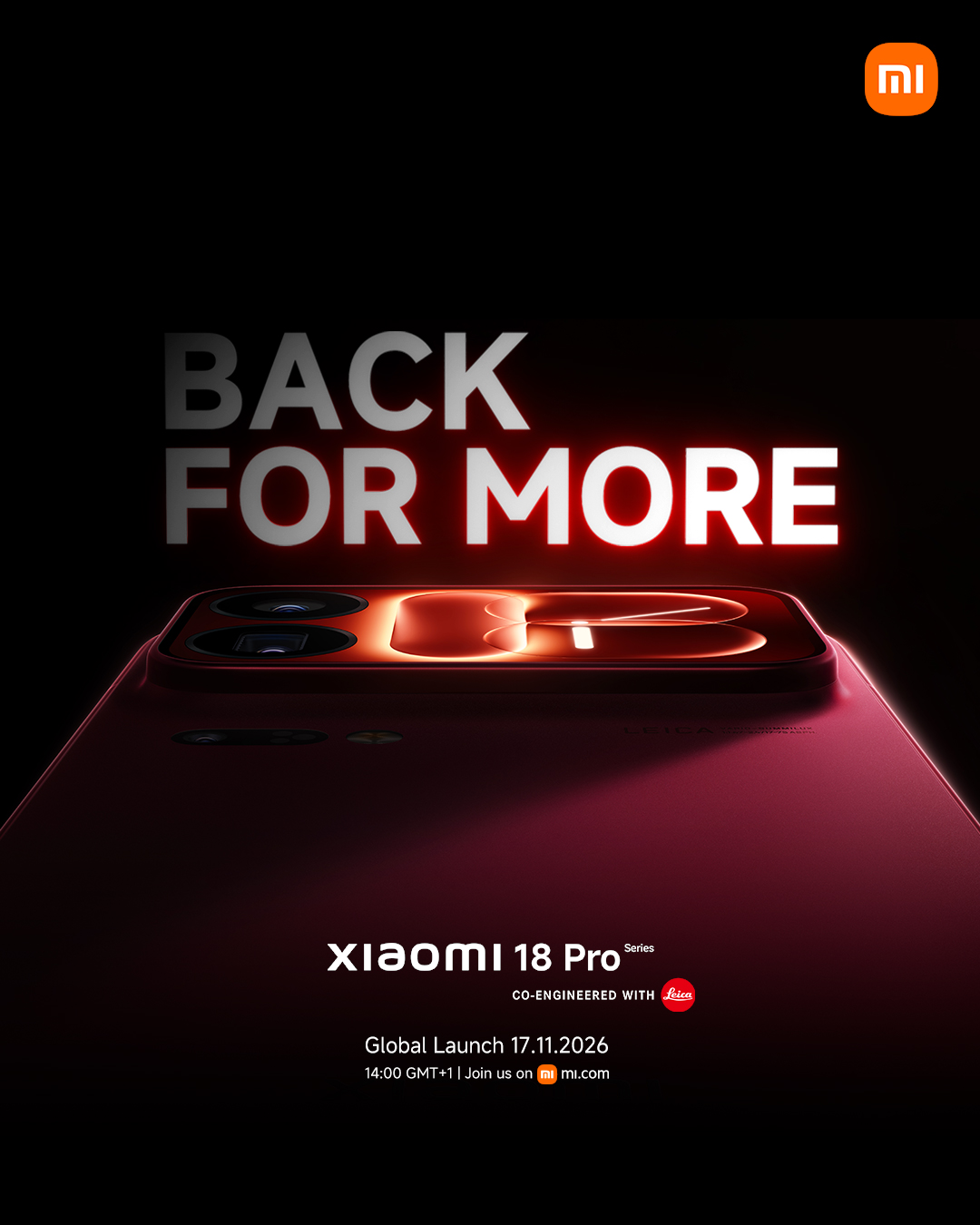
Xiaomi has converted a vague November promise into a dated global event: the Xiaomi 18 Pro and Xiaomi 18 Pro Max will be unveiled internationally in Paris on November 17, 2026, at 13:00 UTC 1. The two phones arrive with the same headline hardware that defined their September China debut, dual 200-megapixel Leica cameras, a rear display, and Qualcomm’s Snapdragon 8 Elite Gen 6 family 2. The more consequential story is what changes outside China: leaked European regulatory and retail evidence points to smaller batteries and substantially higher prices than the Chinese models 3 4.
Separately, a Chinese 3C certification filing for model M261DB, widely believed to be the standard Xiaomi 18, lists 100W wired charging and supports earlier reporting that the vanilla model will arrive later, probably in December in China 5. That filing does not confirm a global launch for the standard model. Readers should therefore treat the November 17 event as a two-phone Pro launch, not a complete Xiaomi 18 family launch.
What Is Confirmed
Xiaomi confirmed on November 2 that the 18 Pro series was going global in November, then followed with the specific Paris date and time 1. The event will be livestreamed on YouTube and X 1. Xiaomi’s own framing emphasizes the Back Display and Leica Dual-200MP Camera System, personalization, imaging, and two sizes 1.
The China launch provides the confirmed baseline. Both phones launched in China on September 23, 2026 2. The 18 Pro uses the Snapdragon 8 Elite Gen 6, while the 18 Pro Max uses the Snapdragon 8 Elite Extreme Gen 6 variant 2. Both chips are built on a 2nm process and use two Prime cores at up to 5.0 GHz plus six Performance cores at up to 4.0 GHz 6.
The Two Pro Models
Displays and Design
The central design decision is that Xiaomi split the Pro line by size rather than treating Pro as one compact phone. The 18 Pro has a 6.4-inch LTPO AMOLED display, while the 18 Pro Max has a 6.9-inch panel 2. Both use variable 1-120Hz refresh rates, 2K-class resolution, 4,000-nit peak brightness, and Dragon Crystal Glass 3 protection 2.
Both phones retain a rear display, now positioned as more than a notification window. Xiaomi demonstrated AI-assisted creation of rear-screen mini apps, including a water-reminder app, an egg timer, and recipe recommendations, alongside custom AI wallpapers, widgets, Xiao AI interaction, and use as a camera viewfinder 2. The rear display is therefore best understood as a secondary interface and a differentiator, not merely decoration.
Both phones also include a hardware-level privacy display. Unlike a simple software dimming mode, Xiaomi’s implementation is described as restricting off-angle visibility and supporting location-based triggers, while also blocking notifications, floating windows, and split-view configurations 2. A dedicated AI button on the left side provides access to the feature 2.
Cameras
Both Pro models share the same triple rear camera system in China: a 200-megapixel main camera using the 1/1.28-inch Light Hunter 960 sensor, a 200-megapixel periscope telephoto with 3.2x optical zoom, and a 50-megapixel ultrawide covering a 102-degree field of view 2. The main camera is 23mm-equivalent and the telephoto is 75mm-equivalent 2. The shared camera system matters because it means buyers choosing the smaller Pro do not sacrifice the headline imaging hardware to save size.
Batteries and Charging in China
In China, the 18 Pro has a 7,000mAh battery and the 18 Pro Max has an 8,500mAh battery 2. Both support 100W wired charging, 50W wireless charging, and 27W reverse wireless charging 2. Both run HyperOS 4 and carry IP69 ingress protection 2.
The Global Compromise: Smaller Batteries
The most important caveat for international buyers is that the global models are expected to use smaller batteries. HyperOS code entries cited by tipster Kacper Skrzypek list the global 18 Pro at 6,000mAh and the global 18 Pro Max at 7,050mAh 3. European energy-label reporting has subsequently pointed in the same direction 7.
| Model | China battery | Reported global battery | Reduction |
|---|---|---|---|
| Xiaomi 18 Pro | 7,000mAh | 6,000mAh | 14.3% |
| Xiaomi 18 Pro Max | 8,500mAh | 7,050mAh | 17.1% |
The percentages above are calculated from the reported capacities. The Pro Max takes the larger absolute and proportional cut, losing 1,450mAh versus 1,000mAh for the Pro.
This pattern is not new. The China Xiaomi 17 used a 7,000mAh battery while the global version used 6,330mAh, about 10% less, and the Xiaomi 17 Ultra fell from 6,800mAh in China to 6,000mAh globally 3. A commonly cited explanation is international lithium-ion transport regulation, particularly in Europe, although Xiaomi has not given an official reason for the 18 Pro series cuts 3.
The practical implication is narrower than the headline numbers suggest. Even after the cut, the global Pro Max would still have a larger battery than the China Pro, and both global models would remain well ahead of mainstream Western flagships on rated capacity. The iPhone 18 Pro Max, for example, is listed at 5,391mAh in one regulatory-based report and starts at $1,299 in the United States 8. Capacity alone does not determine endurance, because display efficiency, silicon, software, and charging behavior all matter, but Xiaomi retains a clear capacity advantage even after the global reduction.
Charging is less settled. The China models support 100W wired charging, while global reporting has mentioned 90W or 100W figures and no confirmed global wireless or reverse-wireless numbers 3. Buyers should wait for Xiaomi’s Paris specification sheet rather than assume the China charging stack carries over unchanged.
Pricing: The Second Global Compromise
Xiaomi has not announced official global prices. The most widely cited leaked European prices come from Dealabs leaker billbil-kun and were summarized by Notebookcheck 4.
| Model | Reported European configuration | Reported price |
|---|---|---|
| Xiaomi 18 Pro | 12GB / 256GB | €1,399 |
| Xiaomi 18 Pro | 12GB / 512GB | €1,599 |
| Xiaomi 18 Pro Max | 12GB / 256GB | €1,599 |
| Xiaomi 18 Pro Max | 12GB / 512GB | €1,799 |
Those figures are approximately €50 lower than an earlier leak and should be treated as unconfirmed until Xiaomi announces pricing 4. The same report lists Black, White, and Velvet Red as standard European colors, with Cosmic Blue potentially sold directly by Xiaomi in France 4.
For comparison, China pricing started at CNY 5,999 for the 18 Pro and CNY 6,999 for the 18 Pro Max in 12GB/256GB form 2. Direct currency conversion is misleading because European prices include VAT, distribution costs, warranty obligations, and different channel margins. Even allowing for those factors, the leaked European entry prices are materially higher than the China entry prices, and the top leaked Pro Max configuration reaches €1,799.
That pricing changes the competitive frame. The iPhone 18 Pro starts at $1,199 and the iPhone 18 Pro Max at $1,299 in the United States, both with 256GB storage 9. Samsung’s Galaxy S26 Ultra launched in the United States at $1,299.99 before an October price increase took its 256GB list price to $1,399.99 10. Xiaomi’s leaked European pricing therefore does not position the 18 Pro series as a low-price alternative in Europe. It positions it as a premium-priced alternative whose case must be made on cameras, battery capacity, charging, the rear display, and privacy hardware, not on undercutting Apple or Samsung.
The Vanilla Xiaomi 18: What 3C Actually Proves
The second GSMArena article concerns a different phone. A 3C listing is believed to cover the standard Xiaomi 18, model M261DB, with 100W wired charging 5. The certification itself does not name the phone, confirm a launch date, or confirm global availability. The December timing in reporting is best read as a probable China release window, not a confirmed global date.
The 3C filing is useful because it establishes that Xiaomi has moved at least one additional 18-series device through a required certification step. It does not establish the phone’s display size, camera system, battery, or final name. GSMArena notes that earlier reports point to a Snapdragon 8 Elite Gen 6 chipset rather than the Extreme version, a 200-megapixel main camera, and a 7,200mAh battery 5. Those details remain rumors.
The sizing logic is also unresolved. GSMArena observes that the 18 Pro is now the compact model at 6.4 inches, so the vanilla 18 may slot between the Pro and Pro Max if its rumored 7,200mAh battery implies a larger body than the Pro 5. That is plausible inference, not confirmation. Other reporting has separately suggested a 6.4-inch display for the vanilla model, which would complicate the size inference and shows why the vanilla model’s position should not be treated as settled.
| Xiaomi 18 item | Status |
|---|---|
| 3C model M261DB | Reported certification filing |
| 100W wired charging | Listed in certification reporting |
| Snapdragon 8 Elite Gen 6 | Rumored, not confirmed |
| 200MP main camera | Rumored, not confirmed |
| 7,200mAh battery | Rumored, not confirmed |
| December China launch | Reported as probable, not confirmed |
| Global launch | Not confirmed |
The Missing Ultra
GSMArena’s Paris article says the confirmed two-model global lineup means the event should not be expected to include the rumored vanilla version or the likely canceled Ultra 1. The Ultra cancellation itself remains a rumor. Tipster Digital Chat Station reportedly said the Ultra was canceled because Xiaomi considered a proposed CNY 9,999 price for a 12GB/256GB configuration too high to sustain sales 11. Xiaomi has not publicly confirmed cancellation.
If the rumor is accurate, it explains the portfolio logic: Xiaomi is not using an Ultra to chase the absolute top of the market this cycle. Instead, the Pro Max becomes the flagship ceiling, while the Pro covers buyers who want a smaller phone without losing the dual-200MP camera system. The absence of an Ultra also removes a potential halo product, which may make the Pro Max’s leaked €1,799 top price harder to justify unless Xiaomi’s camera and battery story proves decisive.
What to Watch on November 17
The Paris event should answer four questions that the two GSMArena articles leave open.
First, Xiaomi must publish the official global battery capacities and charging specifications. The reported 6,000mAh and 7,050mAh figures are credible but not official, and wireless and reverse-wireless charging remain unconfirmed for global models.
Second, Xiaomi must publish official prices by market. The leaked €1,399 to €1,799 range is the best current guide, but regional taxes, storage configurations, and launch bundles can shift the effective price considerably.
Third, Xiaomi must clarify availability by country and date. A Paris unveiling does not mean simultaneous retail availability everywhere, and earlier reporting has noted that regional dates, configurations, and pre-order offers can differ.
Fourth, Xiaomi may use the “more surprises” language in its teaser to introduce accessories or adjacent products. GSMArena speculates about a Xiaomi Watch S5 41mm, currently available only in China, as one possibility 1. That remains speculation, not a confirmed launch item.
The Xiaomi 18 Pro series global launch is real, dated, and strategically significant, but it is not the straightforward import of the China models that a headline date might imply. Xiaomi is bringing its most distinctive hardware ideas, dual 200-megapixel Leica cameras, a functional rear display, and a hardware privacy screen, to international buyers. It is also asking those buyers to accept smaller batteries than the China models and, if leaks prove accurate, substantially higher prices.
The vanilla Xiaomi 18, meanwhile, is a separate and later story. The 3C filing makes a 2026 China launch plausible and confirms 100W charging in certification reporting, but it does not establish a global launch, a firm date, or the phone’s full specifications. The strongest buying advice is therefore narrow: wait for the November 17 Paris specification sheet and price list before comparing the global Pro models with the China models or with Apple and Samsung flagships. The current evidence is strong enough to understand Xiaomi’s direction, but not strong enough to treat leaked batteries, prices, or vanilla-model specifications as final.